




Series 2600 Rolling Ladder
Series 2600 Rolling Ladder. The ladders ship disassembled and have a 50 degree climbing angle; The added feature of this product is larger 1¼" diameter tubing used in the base and in the vertical back panel.
Equipment collection · Page 2 of 2
47 products in this collection
Ladders and low access stands provide access to a defined work area. Match the access arrangement to the task, available space and intended environment.
Review the models and documented specifications below. Include access geometry, rated load and environment in your quote request so the proposed configuration can be checked against your application.
Models in this collection 3 shown
Select models and tell us about your application.
Our team reviews your request and any open questions.
Compare the configuration, quantities and included items.
Select models to compare or request together. Your selection stays available as you browse.
No products selected
Showing 23 of 23 on this page • 47 in this category
Page 2 of 2
Series 2600 Rolling Ladder. The ladders ship disassembled and have a 50 degree climbing angle; The added feature of this product is larger 1¼" diameter tubing used in the base and in the vertical back panel.

Folding Rolling Ladder. Climbing angle is 59 degrees; Pick your color from our 11 stock choices.

Aluminum Rolling Ladder Series A. The climbing angle is 59 degrees; 7" deep steps and 14" deep top step.

Tilt-N-Roll Ladder. Climbing angle is 59 degrees; For steel ladders, pick your color from our 11 stock choices, or choose aluminum or stainless steel.

Straddle Base TILTNROLL Ladder. Climbing angle is 59 degrees; The rated load capacity is 350 lbs.

Industrial Rolling Ladders - Square Tube 60. 1" square-tube technology is more abuse-resistant than conventional round tube design; Models with five or more steps feature 4" casters and our exclusive Ezy-Lock® system, which plants ladder legs firmly to the floor when pressure is applied to the bottom step.

Multi-Directional Ladder — Rolling Ladders. Description: IML multi-directional rolling ladders have four swivel casters which allows precision steering - enabling easier positioning of ladder in tight areas.

Stockpicking Ladders. 1" square-tube technology is more abuse-resistant than conventional round tube design; Steps are 7" deep.

Aluminum Rolling Ladders. Constructed of 1" diameter rigid all-aluminum alloy tubing; Spring-loaded 3" casters compress to engage rubber-tipped legs, which provide traction and secure the ladder in place when in use.
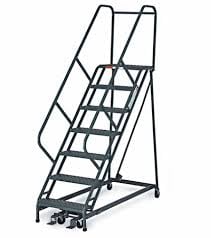
Industrial Rolling Ladders. Steps are 7" deep and available in 16", 24", or 30" widths. Top step is 9 1/2" deep; KD models incorporate a steel sleeve & pin joint secured by a setscrew with nyloc patch.

Cantilever Rolling Ladder CL-6 6 Step. 57 degree slope is standard; 24" wide steps.

Cantilever Rolling Ladder CL-7 7 Step. 57 degree slope is standard; 24" wide steps.

Cantilever Rolling Ladder CL-8 8 Step. 57 degree slope is standard; 24" wide steps.

Cantilever Rolling Ladder CL-9 9 Step. 57 degree slope is standard; 24" wide steps.

Cantilever Rolling Ladder CL-10 10 Step. 57 degree slope is standard; 24" wide steps.

Cantilever Rolling Ladder CL-11 11 Step. 57 degree slope is standard; 24" wide steps.

Cantilever Rolling Ladder CL-12 12 Step. 57 degree slope is standard; 24" wide steps.

Cantilever Rolling Ladder CL-13 13 Step. 57 degree slope is standard; 24" wide steps.

Cantilever Rolling Ladder CL-14 14 Step. 57 degree slope is standard; 24" wide steps.

Cantilever Rolling Ladder CL-15 15 Step. 57 degree slope is standard; 24" wide steps.

Stainless Steel Lockstep Ladders. Listed models: SS052414, SS062414, SS072414, SS082414 and additional configurations; SS052414 STEPS INCLUDING TOP STEP: 5 STEP.

Stainless Steel Spring Loaded Caster Ladders. Type T304 Stainless Steel construction; 1-3 step ladders are all welded and have 10” deep top step.

Stainless Steel Tilt & Roll Ladders. Listed models: SSTR220, SSTR320, SSTR420, SSTR520 and additional configurations; SSTR220 STEPS INCLUDING TOP STEP: 2 STEP.
Start your rolling ladders comparison with access geometry, rated load and environment. Choose a model around the job it must perform and the space in which it will be used. The product grid is a shortlist, not a substitute for reviewing the individual model specifications. Similar product names can describe different sizes, configurations or operating limits.
Record the landing or task height, required top-step or platform elevation, access angle and available footprint. Check the documented load, tread, handrail and movement or securing arrangement. Cleanroom, ESD, marine and electrical-environment requirements need model-specific confirmation rather than material assumptions.
For this collection, useful published fields include Load Capacity. Open the individual product pages to compare the recorded values and supporting details. A missing specification is a reason to ask for clarification, not evidence that the product meets the requirement. The filters use the published values exactly as listed and apply to the products on the current page.
Before requesting pricing, note your preferred model, quantity and any configuration requirements. Describe the application in plain language and identify the constraints that matter most. If you are comparing alternatives, select those models for one request and explain whether you need an equivalent option or a different configuration. This helps our team understand the comparison without treating every selected item as a separate purchase.
UNDERSTANDING YOUR QUOTE
A quote for rolling ladders depends on height, width, construction, tread and mobility or securing features. Quantity can affect the overall proposal, but a discount should not be assumed. Optional features and a different configuration can change the comparison even when the base product looks similar. Identify any custom dimensions or material requirements separately so their feasibility and effect on pricing can be reviewed. Ask for the quoted configuration and included items to be identified clearly before making your decision.
Download equipment catalogsUse the catalog to compare models, then confirm current requirements with our team.
Provide the task or landing height and the required top-step/platform elevation where applicable. Include the available footprint, approach and total user/tool load. Do not substitute a general reach estimate for the model’s listed dimensions.
Key variables include height, width, construction, tread and mobility or securing features. Include quantities and any requested changes so the quote can identify the specific configuration. Custom requirements need review; do not assume every model can be modified.
Yes. Select products using “Include in quote,” review your selection, then open one quote request. Your selected model names and product links are carried into the message. Add the quantity for each item and tell us whether the models are alternatives or items you need together.
Our team reviews the models and application details you provide. If more information is needed, we can clarify the requirements before preparing a proposal. Review the model, configuration, quantities and included items in the quote before proceeding.
Order Picking: Choosing Ladders, Platforms or Vertical Lifts
Start with what the picker carries and how often the location is visited. Height alone cannot tell you whether a ladder or powered platform suits a picking task.
Rolling Ladder Buying Checklist: Height, Footprint and Access
A rolling ladder must fit both the task and the route to it. Specify the standing platform height separately from the highest point someone needs to reach.
Ladder Safety Rules: Selection, Inspection and Placement
Useful ladder rules connect the equipment to the task. A ladder in good condition can still be inappropriate for the work or location.
Commercial Ladder Buying Guide: Translate the Task into Dimensions
A commercial ladder needs to suit the working position and environment. Start with the task rather than assuming a stronger-looking ladder is the right choice.
Ladder Purchasing: A Shortlist Based on Access Needs
A useful ladder shortlist records why each configuration fits the task. Height, capacity and footprint should be explicit rather than implied by the product name.
Rolling Ladder Productivity: Measure the Complete Access Cycle
A rolling ladder can improve access only when users can retrieve, position and secure it efficiently. Measure the full cycle rather than assuming mobility saves time.
Tell us about your application, height, or workspace requirements and we’ll help you identify the right equipment.
No obligation • Industrial equipment specialists