




Lift and Tilt Tables
Lift and Tilt Tables. 90° tilt available as option for table use as coil or crate upender (capacity is derated on tilts greater than 45°); Required on mobile tables with greater than 45° tilt.
Equipment collection · Page 4 of 26
616 products in this collection
Material handling equipment supports the movement, positioning and storage of goods. Start with the load and the complete handling sequence to identify the appropriate equipment type.
Review the models and documented specifications below. Include load characteristics, transfer points and handling route in your quote request so the proposed configuration can be checked against your application.
Select models and tell us about your application.
Our team reviews your request and any open questions.
Compare the configuration, quantities and included items.
Choose a focused collection to narrow your search.
Select models to compare or request together. Your selection stays available as you browse.
No products selected
Showing 24 of 24 on this page • 616 in this category
Page 4 of 26
Lift and Tilt Tables. 90° tilt available as option for table use as coil or crate upender (capacity is derated on tilts greater than 45°); Required on mobile tables with greater than 45° tilt.

Mini Scissors Lift Table. Available up to 250 pound capacities and up to 70" raised height; Electro-mechanically operated; no drift, no leakage(designed for intermittent usage, 25% duty cycle).

Mechanical Lift Table. Lift tables are available powered electro-mechanically by 110 volts AC single-phase power providing effortless operation; Assembly work where heights of components or operators need adjustment, load positioning, transporting materials and transferring load from lower position to high position.

Zero-Low, 3-Point Entry Lift Table. Listed models: ZL3PC-3030E, ZL3PC-3636E, ZL3PC-4242E, ZL3PC-4848E and additional configurations; ZL3PC-3030E Capacity (lbs.): 1000.
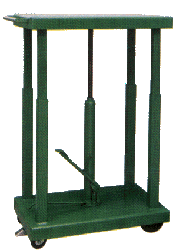
Post Lift Tables. Listed models: PT12-10, PT12-20, PT12-40, PT2436E*; PT12-10 Platform (WxL): 20"x30".

Pallet Inverter — PI-E Models. Listed models: PI-23636E, PI-24242E, PI-24848E, PI-44848E and additional configurations; PI-23636E Capacity lb.: 2,000.

Upender Inverter. Listed models: UI-24848E, UI-24872E, UI-25496E, UI-44848E and additional configurations; UI-24848E Capacity (lbs.): 2,000.

Self Propelled Zero-Low Scissors Lift Table. Listed models: OZLC-5048SPB, OZLC-3466SPB, OZLC-5072SPB, OZLD-5048SPB and additional configurations; OZLC-5048SPB Capacity (lbs): 1000.

Reversible Boom Crane. Electric, either battery (battery not included) or 110 volt a.c; Manual hydraulic lifting cylinder is standard.

Super-Master Mobile Hydraulic Floor Cranes. The heavy-duty hydraulic lifting cylinder on a standard Super-Master is hand-pump operated. Optional battery or 110 volt AC power is available; Can be used as a standard hydraulic shop crane, a mobile crane with 150° mast rotation, and a 360° rotating truck or floor-mounted crane.

Husky-Master Mobile Hydraulic Floor Cranes. Electric (either battery or 110 volt AC) and air power cylinder lift are available; Ruggedly-constructed; will give dependable, long-lasting use.

Truck-Mounted Knuckle Krane. 2,000, 4,000, & 6,000 lbs. capacities; Lift height up to 18 feet.

Truck-Mounted Pick-Up Cranes. Crane includes boom, manual winch, and mast insert assembly. Ideal for mounting on pick-up truck or as a portable shop crane; Same crane can be easily used in various locations.

Truck-Mounted Foldable Hydraulic Crane. Can be powered either by battery or plug-in 110 volt AC; Boom lowers to vertical position enabling crane to be carried by two people; has built-in carrying handles.

Port-O-Giant Hydraulic Floor Crane. 80 in. width provides maximum stability; 60 in. intermediate width; 34 in. minimum width enables crane to pass through doorways or move material down narrow aisles.

V-Master Mobile Hydraulic Floor Cranes. 54 in. wide ideal when wide loads must be straddled; also good for added stability; 32 in. wide design for travel in narrow aisles, passageways and through standard doorways.

Econo-Master Mobile Hydraulic Floor Cranes. Overall width of only 34 in. enables crane to pass through doorways and work in aisles; Electric, either battery or 110 volt a.c., and air power are optional.

Floor-Mounted Jib Crane. Ideal when overhead cranes are not practical.

Telescopic Mast Jib Crane. Unit can rotate under obstructions or reach into a cavity to pick up the load, then rotate and raise to a higher level over the obstruction below.

A-Frame Gantry Crane. Use as a portable gantry crane -- space savings for transportation and storage when not in use. Crane can be assembled in less than 15 minutes; The ideal crane for repair, service, and assembly operations conducted in fixed locations.

Tele-Mast Straddle Crane. Handling shipping containers; Loading and unloading trucks.

Jib-Master Forklift Cranes. Listed models: JB-1, JB-2, JB-4, JB-PB6 and additional configurations; JB-1 Description: 3,000 lbs. cap. 144" reach, telescopic boom action, no boom lift.

Articularm. Available in 500, 1000, and 2000 pound capacities; Mini-Articularm available in 200 pound capacity.

Universal-Lift. Hydraulic system is equipped with a pressure relief valve to prevent overloading; Remote control available so operator can control safely from various locations.
Start your material handling equipment comparison with load characteristics, transfer points and handling route. Choose a model around the job it must perform and the space in which it will be used. The product grid is a shortlist, not a substitute for reviewing the individual model specifications. Similar product names can describe different sizes, configurations or operating limits.
Record load mass, dimensions, center of gravity and contact points, including any container or fixture. Map pickup, travel and delivery positions, floor transitions and available space. Review the chosen model’s load limits and interface requirements before comparing configurations.
For this collection, useful published fields include Capacity, Platform Size, Lift Capacity, Overall Width, Voltage. Open the individual product pages to compare the recorded values and supporting details. A missing specification is a reason to ask for clarification, not evidence that the product meets the requirement. The filters use the published values exactly as listed and apply to the products on the current page.
Before requesting pricing, note your preferred model, quantity and any configuration requirements. Describe the application in plain language and identify the constraints that matter most. If you are comparing alternatives, select those models for one request and explain whether you need an equivalent option or a different configuration. This helps our team understand the comparison without treating every selected item as a separate purchase.
UNDERSTANDING YOUR QUOTE
A quote for material handling equipment depends on capacity, dimensions, operating mechanism and application-specific interfaces. Quantity can affect the overall proposal, but a discount should not be assumed. Optional features and a different configuration can change the comparison even when the base product looks similar. Identify any custom dimensions or material requirements separately so their feasibility and effect on pricing can be reviewed. Ask for the quoted configuration and included items to be identified clearly before making your decision.
Download equipment catalogsUse the catalog to compare models, then confirm current requirements with our team.
Include the complete load weight, dimensions and center of gravity where known, plus pickup and delivery heights. Describe how the load is supported, moved and transferred; total weight alone is not enough.
Key variables include capacity, dimensions, operating mechanism and application-specific interfaces. Include quantities and any requested changes so the quote can identify the specific configuration. Custom requirements need review; do not assume every model can be modified.
Yes. Select products using “Include in quote,” review your selection, then open one quote request. Your selected model names and product links are carried into the message. Add the quantity for each item and tell us whether the models are alternatives or items you need together.
Our team reviews the models and application details you provide. If more information is needed, we can clarify the requirements before preparing a proposal. Review the model, configuration, quantities and included items in the quote before proceeding.
Specialized Industrial Supplies: Write Application-Based Requirements
Specialized procurement works best when the request states why a standard item does not fit. Avoid substituting a broad industry label for measurable requirements.
Scissor Lift Tables: Load Geometry Matters as Much as Capacity
A material lift table raises goods to a useful working or transfer height. Select it using load distribution and the complete lifting range, not just nominal capacity.
Scissor Lift Tables and Safety: Review the Complete Workstation
A lift table may improve load positioning while introducing pinch points and transfer hazards. Assess the table as part of the workstation.
Warehouse Operations: Eleven Checks for a Practical Improvement Plan
An operations review should produce measurable actions, not a list of broad promises. Walk a complete order from receiving through dispatch and note where the process stops.
Aerospace Manufacturing: Build Equipment Lists from the Process
Aerospace production equipment needs vary by part, process and quality system. Start with the work sequence rather than a generic list of factory essentials.
Equipment Buying Groups: Evaluate Savings Beyond the Discount
A buying consortium can coordinate demand, but the advertised discount is only one part of the decision. Compare the same equipment specification and service obligations.
Tell us about your application, height, or workspace requirements and we’ll help you identify the right equipment.
No obligation • Industrial equipment specialists